

Stakeholder Analysis: Mendelow’s Matrix
17 January 2025
Don’t Start Eliciting Without a Plan! How to Structure Your Requirements Discovery
26 October 2025Functional vs. process view — according to Paul Harmon
As a consultant who teaches business process modeling, I’m often asked to explain foundational concepts. Recently, a student posed a brilliant question: “What’s the actual difference between how a company is organized and how work actually gets done?”
This question lies at the very heart of business analysis. The answer requires understanding two distinct but complementary perspectives every organization has: the functional view and the process view.
Paul Harmon, in his book “Business Process Change”, distinguishes two complementary ways of understanding how organizations work:
-the functional view, and
-the process view.
Each represents a different perspective of how value is created and how work is managed. Harmon argues that while both are legitimate and necessary, modern performance improvement depends on an organization’s ability to move beyond purely functional thinking and adopt a process-oriented perspective.
The functional view–vertical efficiency
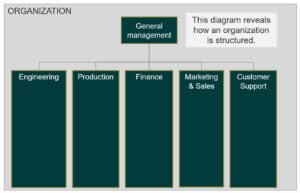
Functional view
The functional view is the traditional way organizations are structured. It divides the work into specialized departments, each responsible for a specific function such as marketing, production, finance or human resources. People with similar expertise are grouped together so they can build deep knowledge, standardize their practices, and achieve efficiency within their domain. This structure supports clear lines of authority and accountability. Managers within a function optimize resources, define procedures, and monitor performance indicators that relate to their area, such as departmental productivity or cost control.
In the functional view, the organization appears as a hierarchy, with the CEO at the top and departments arranged vertically underneath. Each unit operates with high autonomy and typically pursues its own goals and performance metrics. Communication and coordination across departments occur through handoffs — the transfer of work products or information from one function to another. While this view brings stability and specialization, Harmon notes that it also tends to produce silos. Each department becomes efficient at its own tasks but often at the expense of overall performance. As work moves between functions, delays, rework, and misunderstandings occur because no one is directly responsible for the entire flow from customer request to product or service delivery.
Harmon calls this local optimization: each department seeks to improve its own operations, but the organization as a whole may still perform poorly from the customer’s point of view. Traditional management information systems reinforce this separation by reporting results by function rather than by the total experience of the customer or the end-to-end performance of a value chain.
The process view–horizontal value creation
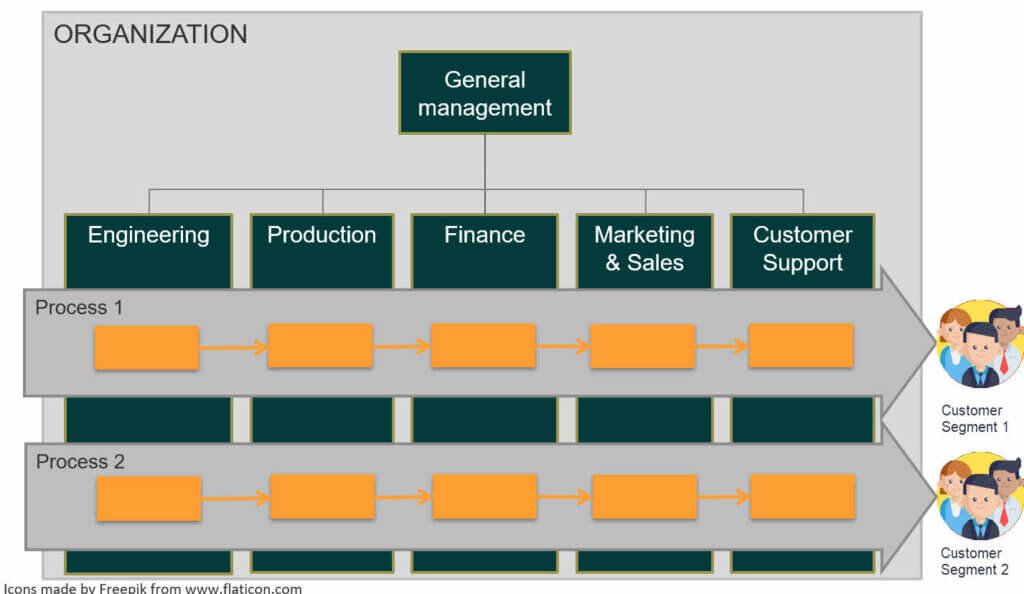
Process View
The process view cuts across this vertical structure and focuses on how value is actually created and delivered. A business process is an end-to-end sequence of activities that together achieve a specific outcome for a customer or stakeholder. Typical examples include “Hire-to-Retire” and “New Product Development.” These processes cross-functional boundaries and need collaboration among departments.
In the process view, the organization is seen horizontally: workflows through marketing, sales, production, logistics, and accounting, but the process itself is the unit of analysis. The focus is not on who performs the task, but on how the flow of work transforms inputs into valuable outputs. Performance is measured by process indicators such as lead time, cost per transaction, error rate, and customer satisfaction.
Harmon explains that adopting a process view shifts management attention from isolated functional performance to end-to-end value delivery. The goal becomes to improve the total process so that the customer receives faster, higher-quality, and more consistent service. This view underpins the discipline of Business Process Management (BPM), which Harmon describes as a horizontal management system layered over the traditional hierarchy. BPM introduces roles such as process owners, who are accountable for results that cross departmental boundaries, and continuous improvement mechanisms such as process modeling, measurement, and redesign.
Comparing the two views
In essence, the functional view is vertical and inward-looking, while the process view is horizontal and outward-looking. The functional view emphasizes specialization, control, and efficiency within each domain; the process view emphasizes integration, coordination, and effectiveness from the customer’s perspective.
From a modeling standpoint, the functional view is typically represented by an organizational chart or functional decomposition diagram, showing who reports to whom and what capabilities exist within each department. The process view, on the other hand, is represented by flow diagrams, BPMN models, or value chain maps showing how work moves through the organization. Harmon often uses “swimlane” diagrams to connect both views — each lane represents a function, while the process flow runs horizontally through them, making visible where handoffs and delays occur.
Performance metrics also differ. Functional managers look at departmental efficiency and utilization, while process managers look at overall cycle time, throughput, and customer value. The functional perspective asks, “Who handles this activity?” The process perspective asks, “How well does this activity contribute to the overall flow of value?
Integration rather than replacement
Harmon cautions against seeing the process view as a complete replacement for the functional view. Functions are still essential; they provide a home for professional expertise and manage resources. No process could operate without the skills and discipline that functional departments supply. The key, thus, is integration. Organizations must recognize that they are both vertically and horizontally structured systems.
To achieve this balance, Harmon suggests creating a process architecture, which is a broad outline of key value-generating processes. These processes are then related to organizational units that implement them. This architecture allows management to:
-identify process owners,
-align strategic goals with end-to-end processes, and
-establish governance mechanisms that coordinate functional and process priorities.
In mature organizations, functional managers and process owners share responsibilities: one ensures that people and resources are available, while the other ensures the process delivers results that meet customer and organizational expectations.
How business analysts use both views
Your value as a BA comes from being fluent in both the language of functions and the language of processes.
1. When starting an assignment:
Use the functional lens to identify who you need to talk to. Map the stakeholders, decision-makers, and teams. Understand the political landscape and policy constraints.
Technique: stakeholder map, RACI, organizational chart, capability map.
Use the process lens to understand what you need to talk about. Define the process scope: What triggers it? Who is the customer? What is a successful outcome?
Technique: SIPOC, high-level process map, current-state BPMN/swimlane diagrams, value stream map, pain-point log.
2. During analysis:
Use the functional lens to uncover capability gaps. Do people have the right skills? What training is needed? What compliance rules must be followed?
Use the process lens to identify flow inefficiencies. Where does work wait? Where do we do rework? Can we remove, simplify, or parallelize steps?
3. In measurement & governance:
Functional KPIs tell you how efficiently resources are being used (e.g., utilization rates).
Process KPIs tell you how effectively value is being delivered (e.g., lead time, quality).
Governance: The ideal model blends both. A process owner is accountable for the end-to-end outcome, while functional managers are accountable for providing skilled people and resources.
Sample questions to uncover each view
In your next workshop or interview, you may try the following questions:
To understand the functional view:
-“How is your team’s performance measured, and who defines those goals?”
-“What specific expertise or unique capabilities does your team have that others in the organization rely on?”
-“When your team needs to get a decision made, where do you go for approval?”
To understand the process view:
-“Could you please describe the complete process, starting from when it begins until when it is finished?”
-“Where does the work spend the most time waiting?”
-“How often are cases resolved accurately on the initial attempt, with no need for further work?”
The final takeaway
Customers don’t make purchases based on the company structure. They experience the business processes that your organization implemented and executes. Mature, high-performing organizations don’t choose between building expert internal functions and focusing on customer-driven processes—they master both.
As a business analyst, your superpower is:
-the ability to see the organization through both lenses at the same time,
-to ensure both views align to drive meaningful change.
As Harmon says (paraphrased):
“The customer doesn’t experience your departments; they experience your processes.”
Balancing the two views—functional for stability and expertise, process for agility and customer focus—is the hallmark of a mature, process-managed organization, and business analysis contributes to that.
Learn More with BA Coach
Would you like to develop your competencies to model, analyse, and improve business processes?
Our EXIN BCS Foundation in Business Analysis and EXIN BCS Modelling Business Processes courses explore these perspectives in depth. You’ll learn to connect organizational structure with process flow, using real-world cases and practical exercises.
👉 Visit our Calendar to discover upcoming training dates, delivery formats (classroom, virtual, or e-learning), and certification options.
References:
Pictures: Image by freepik